Showing posts with label Korean War. Show all posts

Wednesday, September 11, 2013

Fort Sam Houston

(click here to read previous story: The Move to San Antonio)

Dinon was drafted into the army in August of 1953, just two months after graduating from college.  His first stop for basic training was in Fort Riley, Kansas, followed by a few months in Camp Pickett, Virginia, before it closed in June of 1954.  Between Camp Pickett and Dinon's release from service in May of 1955, Dinon spent his time - "over a year" - at Fort Sam Houston in San Antonio, Texas.

(Source)
"When I got down to San Antonio, I was assigned to a training battalion headquarters as a clerk typist." Dinon said.  "I did not, of course, go to a typing school, but they assigned that to me.  I had to run the message center at battalion headquarters."

According to Dinon, it was an easy job, consisting of four plain eighteen-inch square boxes.

"One was Company A, B, C and D, and my job was to take the mail, and if it said ‘Company A’, I put it in the ‘Company A’ box.  I mean, it was ‘really tough’, ha," he said, chuckling.

In addition to sorting, he was also the driver for the colonel.

"He was a light colonel, so he was a lieutenant colonel, he wasn't a full bird colonel (full bird colonel has eagles as a symbol – he only had a silver star, a full colonel’s is brass)," Dinon explained.   "So I had to pick up the jeep every morning, drive it over there, and then when the colonel wanted to go watch his troops being trained, why, I drove him to wherever they were training.  And if he noticed some training on the other side of the valley, there was no road, you just went straight there, which means you’re going cross-country in the jeep with the colonel next to you.  Then he’d get out and inspect the troops and all and see what they’re doing, and then I’d bring him back, and then at the end of the day I had to wash the jeep and leave it at the motor pool where all the trucks and jeeps were kept."

Example of a 2-1/2 ton cargo truck
(Source)
Another part of his driving responsibilities was learning how to operate a two-and-a-half ton truck, AKA, 'a deuce-and-a-half'.

"It was one of these great big things with the canvas over the back, monster things," he said.  "I remember at the very end [of the driving test], driving that thing out in the field, and here’s this steep hill.  So I come up to the hill, and I brum! revved it up, and all I could see was sky!  The thing was almost vertical – I couldn't see the road!  I’m looking out the windshield, and the windshield is pointing up!  But I passed, and he gave me the driver’s license for it ... I don’t think I ever had to drive one after the test, but I was certified.  They do that, they train you in a number of things in case you need it."

Dinon never went overseas or saw military action.  Even though he had been drafted for 24 months, he was released in May of 1955.  "I only served about 21 months because Congress would not appropriate enough money to keep the army as big as the military wanted," Dinon said.


Dinon left the military and did not return.  On August 26, just three months later, he and Liz were married.  And, in that same year, Dinon used the benefits of his G.I. Bill of Rights to re-enroll at the University of Wisconsin to pursue a master's degree in business.


(Next story: New Wife, New Life)


SIMILAR STORIES
A Pair of
Fiancees
Ecumenical
Conference
Dorms, Food
and Studies


Wednesday, September 04, 2013

The Move to San Antonio

(click here to read previous story: A Pair of Fiancees)

In June of 1954, Camp Pickett was closed and the men on base, including Dinon, were ordered to pack up the camp and relocate.

"They decided to close the camp, so I’m going through the medical kits and separating them out: I mean, scissors and things, y'know," Dinon said.  "One of the things in the kits were knives, X-Acto knives, and they were used for surgery and were manufactured real well.  They were supposed to be well-sealed, but in some cases the seal was not quite perfect, and so they’d get rust in there – which made them not good for surgery."

Even though he was instructed to throw everything away, he kept some of the knives - and he still uses them for his model railroad hobby today.

"Each packet had about half-a-dozen or so knives, so I've used them over the years and I still have some downstairs for my railroad set," he said.  "I have two kinds – one of them has a curve, and the other one has a straight edge.  I've had those ever since my time in Camp Pickett, Virginia.  And I've been very glad."

In addition to sorting the medical supplies, Dinon also spent early mornings in the kitchen near the end of his stay in Camp Pickett.

(Source)
“It came to the point near the end where I was having to pull KP – kitchen police, pots and pans, spotless spotless, you were the dishwasher.  You had to make sure that all the grease was removed when you washed them," Dinon said.  "So I was having to pull KP duty, which means you have to get up real early in the morning, I don’t know, 4, 4:30, help with preparing the breakfast, and there were fewer and fewer soldiers there, and then finally they shipped me down to Fort Sam Houston in San Antonio, Texas."  He was shipped to Texas at some point in the first half of 1954, prior to the June closing of Camp Pickett.

This was difficult for Liz.  She had not yet earned her college degree, so she stayed in school at Maryland to continue her studies while Dinon moved 1,600 miles west to San Antonio.  They continued to correspond over the distance, but, as the months went by, the recurring name of a woman in Dinon's letters began to alarm Liz.

"In San Antonio, there was a Methodist church in town.  At the church, why, you had an opportunity that if you helped serve the meal on Sundays - and they had a really good meal - you got yours free!  So I always helped serve, so I always got my free meal," Dinon said.  "Well, they had a really active young people’s group there, and Liz kept noticing as I was writing her that I kept mentioning this one girl named Jane Batow.  She was in the youth group, and I was just telling Liz what I was doing, but her name kept popping up."

Liz was smart enough to see the risk.  After all, Dinon had already broken off one long-distance engagement in favor of a woman that lived close by, so she knew that there was a possibility of a repeat with this Jane Batow.

Valuing Dinon over her degree, she left Washington Missionary College in the winter of 1954.

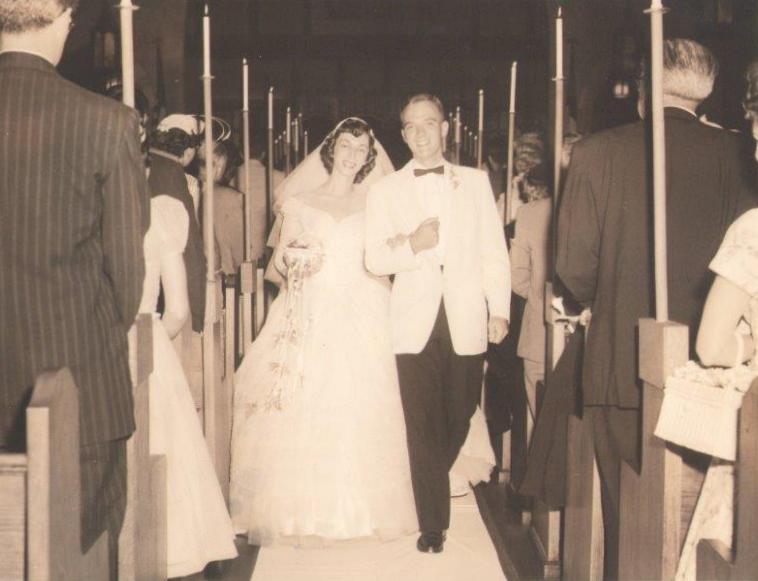
Wedding Day: August 26, 1955
Three months after Dinon's release from the army
"Liz said to herself, 'I think I better go down and watch over, and make sure he doesn't stray'.  So, she came down, oh, toward the end of the year, so she probably came down before Christmas and she was there several months, working and keeping her eye on me and keeping me busy," Dinon said.  They continued to date and her efforts paid off - they married in August of 1955, shortly after Dinon left the service.


After her move to Texas, Liz did not return to college or earn a degree.  "I don’t think Liz had a degree in mind," Dinon said.  "She liked to write, so maybe it was kind of like journalism, I guess, or something."  Later in life, Liz expressed regret for never finishing school.  

During their time in Texas, Liz worked as a church receptionist.  She was a smart and very personable woman, and she fit the job well.

But during that year in San Antonio, before his discharge and before the wedding, Dinon continued to learn lots of new things in his last year in the army.

(Next story: Fort Sam Houston)

SIMILAR STORIES

A Pair of
Fiancees
Ecumenical
Conference
Dorms, Food
and Studies


Wednesday, August 28, 2013

A Pair of Fiancées

(click here to read previous story: An Ecumenical Conference in Illinois)

Near the end of 1953, Dinon was in a predicament.

Before his graduation in the spring of 1953, Dinon had exchanged letters with a pretty girl named Liz Marshall.  He had met Liz by chance at an Ecumenical conference in Illinois, but they had only corresponded for a short time and never expected to meet again because of the +1,000 miles between The University of Wisconsin and her school in Silver Spring, Maryland.


Present-day photo of the entrance to
Washington Adventist University
(Source
But now, drafted into the army for the Korean War soon after his graduation, Dinon was stationed at Camp Pickett, near the town of Blackstone, Virginia.  His family and fiancée were more than a thousand miles away back home in Wisconsin Rapids ... but Liz was still going to school at Washington Missionary College (now called Washington Adventist University), which was a little north of D.C. and less than 200 miles away from Camp Pickett.

The proximity that had previously been a disadvantage suddenly became an advantage for a lonely soldier far from home.  So, in spite of his engagement to Dorothy Brown back in Wisconsin, he reached out to Liz and reconnected with her.

"Camp Pickett was close enough that you could find someone to take you into Richmond or D.C.  ... So while I was there, I went to Washington, D.C. a few times to visit Liz.  I guess I was lonely or something like that," Dinon admitted.  "I thought, well, she’s a girl, so, OK.  So I went to see her several times."


Dinon grew to like Liz more and more as he continued to date her and, regardless of his fiancée back home (whom Liz knew nothing about), he fell in love with her.  After just a few weeks, Dinon proposed to Liz ... 

... while he was still engaged to Dorothy Brown back in Wisconsin.

Quite the predicament.

Shortly after proposing to Liz, he sat down with her and confessed, "I think I'm in love with you, but I'm engaged to another girl back home.  What should I do?"

She was furious.

"Don't ask me to tell you what to do!  You've got to make up your mind!"

While retelling the story more than fifty years later, Dinon laughed.

"It was proper for her to say that," he said.

Dinon's parents, Ralph and Alma
Liz went back to school and left him to make his choice: Liz or Dorothy.

It's likely that Dinon asked his parents for advice.  If so, his mother probably advised him to choose Dorothy.

"I don’t think my mother really liked Liz," Dinon said.  "She was sure that, since Liz came from a divorced family, we would divorce at some time, too."  And back in Wisconsin there was his hometown fiancée, Dorothy Brown, a girl that his mother liked so much that she had helped Dinon pick out the engagement ring.

But for some reason, reasons that even Dinon can't quite remember, he chose Liz.

"I don’t know why I picked her," he said.  "I really don’t know.  I guess I liked her better.  Or it could've been because she was current, y'know, since I was seeing her right then."

1954: Photo of Liz with unknown child
Whatever the reason, he made his choice and he followed through: He went to Dorothy and he broke off their engagement.

"She gave me back the ring," he said.  "She could've kept it, obviously, but she gave it back."

Shortly after that, a dozen red roses arrived for Liz Marshall at the dorms in Washington Missionary College.  And everyone heard about it: she ran around the halls of the dorms, joyfully shouting, "He sent me roses!  HE SENT ME ROSES!"

However, their relationship was tested again not long after that.  Camp Pickett was being closed, and Dinon was being relocated to Fort Sam Houston more than 1,600 miles away in San Antonio, Texas.


Wednesday, August 14, 2013

Camp Pickett

Whoops!  We are currently experiencing technical difficulties with this entry - please check back later.  Thanks for your patience while we fix the problem!

Wednesday, August 07, 2013

Basic Training at Fort Riley

(click here to read previous story: The University of Wisconsin - Graduation)

Dinon graduated from the University of Wisconsin in June of 1953.  While working at a camp that August, he got the call.

The timing of his draft is interesting when compared to the timeline of the Korean War, which was considered to have ended with the Armistice Agreement that was signed on July 27 of 1953.  Dinon got his call in August of 1953.

A map showing the location of Fort Riley
(source)
"By that time, the Korean Armistice had been signed, so we were there just in case something happened," Dinon said.  "I was drafted for two years, but only served about 21 months because Congress would not appropriate enough money to keep the army as big as the military wanted."

The first thing that happened to Dinon was basic training.

"Now, basic training is broken up into two sections: one is the basic that everybody goes through, and then the second part is for a specialty," Dinon said.  "I was in the medics: I knew how to give a shot, bind up somebody’s wounds.  But I first started out in Fort Riley, Kansas, that's where I went through the basic."

Fort Riley, named for Major General Bennett C. Riley, is a U.S. army installation located on the Kansas River.  It was established  in 1853 to protect the people and trade traveling the Oregon and Santa Fe trails, and later provided protection to the building of Kansas railroad lines.  In the early 20th century, Fort Riley was also identified as ground zero for the 1918 Spanish flu pandemic.  During World War II, approximately 125,000 soldiers were trained at Fort Riley, and many Korean War soldiers were also trained here.
Young Dinon in his
army uniform

Part of the army dress code was a requirement to remain clean-shaven.  This was easy enough for Dinon when he had access to his electric razor in the barracks, but out in the field he had to rely on the light color of his hair.

"I mean, I wouldn't know how to shave with a straight razor," Dinon said.  "I was glad that my beard was very light and not easily seen - it was there, but you really had to look for it, so I got away with not shaving and then I shaved when I got back to the barracks.  I was just glad that I escaped detection."

During training, Dinon did well enough on the rifle range to qualify as a sharp shooter.

"I never shot a gun before going into the army, but I paid attention to what you’re supposed to do for aiming and so on, and I guess I was steady enough that I could do that," Dinon said.  "I never had to do anything with it, but that’s what I was designated anyhow."

He remembers one night that he was on guard duty for the finance office, where the payroll was.

"The sergeant in charge of the guards said, 'Tomorrow, I either want to find the money in there, or a dead soldier,' and so, we got the idea, 'OK, I guess we better pay attention'," Dinon said.  "Now, we had live ammunition that night, which we hadn't really had much of before ... Well, I was on guard duty, and it went all right."

An M1903 Springfield Rifle: this model, possibly
used by Dinon, was used as a sniper rifle during
the Korean War and is still used as a military
drill rifle
(source)
While at Fort Riley, Dinon also participated in the drill team.

"I got involved in a group where there'd be a bunch of us practicing, and you’d learn how to manipulate your gun and display it for parades and the like," Dinon said.  "So, for instance, if you were in the front, we'd be marching along, then you'd place your gun and walk away from it and then the guy right behind you, having done the same thing, he picks up your gun and the last guy ends up with two rifles.  We'd march around, and do different twirling and so on, and I thought that was fun."

After the first part of his basic training was completed, he was sent to Camp Pickett (now Fort Pickett) in Virginia for continued training as a medic.


Tuesday, July 30, 2013

The University of Wisconsin: Graduation

(click here to read previous story: Snowstorms and Cross-dressing)

In 1950, the U.S. became involved in the Korean War.  As long as Dinon was in college he had a deferment, but the moment he graduated he would be eligible for the draft.

He finished his final exam in the spring of 1953.  At that time, he was engaged to a girl named Dorothy Brown.

"I really don’t remember a lot about Dorothy, but we were engaged, and I actually proposed.  She had a ring and my mother helped pick it out, as a matter of fact," he said.
"She was from Wisconsin Rapids ... I don’t remember an awful lot about Dorothy. I don’t even remember what she looked like."


University of Wisconsin graduation in Field House
Class of 1953 - UW's 100th Commencement Ceremony
(source)
The graduation ceremony did not take place immediately after his final exam. The gap was large enough between exams and commencement (scheduled for June 19th) that Dinon took a position teaching 'camping skills' at a nearby lakeside summer camp.  He even headed out there to work for a while until the ceremony.

"I had to hitchhike to the camp, and then hitchhike back for the graduation ceremony," he said.  According to Dinon, hitchhiking used to be a common method of transportation at the time.  "But in my senior year of college, it was getting harder to hitchhike.  There were just a few [bad and publicized] incidents, but it was enough that the public was starting to get concerned about picking someone up, because there were some [hitchhikers] that would do something to the driver, rob them, or whatever.  So, people were a little more cautious, so I made sure I looked well.  I had to wait longer for my rides but I'd eventually get one."

"So, I came back and went through graduation.  At that time, Wisconsin was one of the largest universities in the country, and the graduation ceremony was in the stadium," he said. "After the ceremony, and after all the pictures were taken, I was walking back to turn in my cap and gown."


A 1955 photo of Camp Randall Stadium,
where Dinon's graduation ceremony took place
(Source)
On that walk back, he ran into his first-year roommate, Kip, the Norwegian.  Kip had just graduated as well, with honors ("He took an easy course for his degree, some kind of 'Studies'").  While catching up, Kip looked over at Dinon's bundled-up commencement robes and asked where his honor cord was.

"I said, 'What are you talking about?', and he said, 'Didn't you go up to Bascom Hall and check the list of who’s eligible to be graduating with honors?'  Turns out I was eligible ... but I didn't know it!  So here I am, I'm on the way back to turn in my cap and gown, and Kip tells me that I was on the list because he knew he was going to graduate with honors because he got good grades all along.  I had had five D’s in chemistry to overcome ... So, I found out just by accident that I’d graduated with honors, but on my transcript it does show 'honors'.  So, you send away your transcript to companies that you want to have hire you, why, they’re gonna see that.  But my parents, of course, didn't have the ability to take the nice pictures with the cord."

Even though his deferment ended with his graduation, he waited to be called.

"I think it was in August or something like that, that they caught up with me," he said.  "At that time, I was working at the camp.  They knew it was a possibility I might be drafted, but they didn't know when.  So, then I got the call from friends and neighbors, so I went back home.  I had to leave the camp, even though they weren't quite done with the season, but it was pretty well advanced, and I didn't have any choice and they knew it.  I wasn't afraid – was too dumb to be afraid, probably.  That would've been in 1953."


SIMILAR STORIES
Wisconsin
Rapids
Dorms, Food
and Studies
Snowstorms
and Cross-
Dressing


Wednesday, July 24, 2013

Snowstorms and Cross-dressing

Snow at the University of Wisconsin, 1958
(Source)
(click here to read previous story:

Dinon's transcript proves that he did well at college, showing that he graduated with honors.  But from the stories he tells, it's clear that he also had a lot of fun along the way.

"The University of Wisconsin is very hilly, and when we had a snow storm, we liked to get on the hills and make them really icy to slide down before the maintenance crew came out with the sand and the shovels," Dinon said.  "I had an early class, so I’d just get up a little earlier and we had a BALL sliding down the hills.  As more guys and gals slid down the hills, it became more icy and it was really fast!"

He also said, with a wink and a smile, that he went out on a lot of dates with a lot of girls.  When the occasion was there, some of those dates were enjoyed at the college's school dances.

"We oftentimes had different contests for king and queen of a dance or something like that, and we’d put on skits to try and attract people watching the skit to vote for them.  There were several people vying for the same honor of the king and queen," Dinon said.  "One year, they were [vying] in the place where we were eating, and one of the guys took a tray and he put a bunch of silverware on it, and then partway through the skit he emptied that tray on the terrazzo floor, and it made a racket.  A lot of people interpreted the noise that, he was going along, just watching the skit, and he wasn't watching, and then he dropped the stuff on the floor accidentally.  Everybody just laughed about that.  But it was on purpose and it had its effect, that’s all we were worried about.  So, it was fun."

But it was the antics of the Haresfoot organization that amused him the most, even as just an outside observer.


Haresfoot actors backstage: Feb 27, 1961
(Source)
"Haresfoot was an organization of men only, and annually they always put on a show over a weekend where they’d have the chorus line, like The Rockettes, y’know, and the guys would dress up as women and get wigs and so on and ... y'know ... stuff their braziers ... and they were good," he said.  "[Haresfoot] was a good organization and some of the guys were quite creative in using that for something else ... and one of the fraternities decided that they’d like to play a prank on their fraternity president."

A big dance was coming up ... and one of the guys had a buddy in Haresfoot.

The fraternity members went to the president's girlfriend for help pulling it off.  "Just before the dance, tell him you're sick," they said, "Since he's the president, he'll have to have a date, and we're going to fix him up."

The day of the dance arrived, and the president received a call from his girlfriend: she was too sick, he'd have to find someone else to go with.  Now he had to scramble to find a suitable available girl at the last minute.  "We've got a girl for you," his fraternity brothers said.  "She's in the dorms, we'll give her a call and set you up."  The president agreed, and arrangements were made for his date to meet him at the fraternity house.

"When the fraternity president came downstairs after dressing for the dance, well, here’s this girl, standing at the fireplace, kind of leaning on the mantle and really nice-looking, and, well, he was really pleased.  So they go to the dance together and, oh, he has a good time," Dinon said.

Like a gentleman, the president walked his date back to the girls' dorm after the dance.

"Now the practice at the time was to give the girls a curfew, the University thinking that if you control the girls, you control the guys ... it’s not quite true, but maybe largely so.  So, on Fridays and Saturdays the curfew was 1230 or something like that," Dinon said.  "So then it comes the time, because of the curfew, to take his date back to the dorm so she can get in.  Well, everyone kisses right at that time, right before the girls go in the door they kiss them goodnight."

So, the president - still oblivious - tells his date what a nice time he had, and leans in for a goodnight kiss ...

" - and then the date whips off his wig – so that you could see he’s a guy – then he SPLITS down and gets out of Dodge!"


A Haresfoot production: 1946
(Source)
Dinon began to laugh.

"The fraternity president - he didn't know what to do!  Because he realized he’d been HAD," he said, laughing.  "That was REALLY funny."

There were plenty of other gender-bending pranks that the Haresfoot boys loved to pull as well.

"On another day, some of the guys were swimming naked in the pool," Dinon said.  "Well, a couple of the Haresfoot guys got dressed up and walked into the pool area.  And, the other guys SPLIT, man, they couldn't get out of the pool quick enough to get away from these 'girls' walking along the pool!  And then, they walked into the shower area – I mean, it was CHAOS until they revealed that they were from Haresfoot.  It created quite a stir at the time ... but, it was funny, it really was funny."

Their fun contrasted against the events of the outside world: in June of 1950, the end of Dinon's freshman year, the Korean War began.  Each year, more young men, like those from Haresfoot, graduated from The University of Wisconsin ... and, in so doing, lost their college deferment and were drafted.  

Which is exactly what happened to Dinon in 1953.


(Next story: Graduation)