Showing posts with label Massachusetts. Show all posts

Wednesday, October 09, 2013

Hospitals, Doctors and Surgeries

Itty-bitty Sharon helping
with the vacuuming
(click here to read previous story: Family of Four)

In 1962, Dinon's three-year-old daughter Sharon developed a urinary tract infection.  The infection was successfully treated with antibiotics - but then it came back.  And came back again.  And again. 

"You could cure it temporarily with antibiotics, but it wouldn't stay cured," Dinon said.

He and Liz were worried about the persistence of the infection, so they began a long string of hospital visits with Sharon.

"She was not only at the hospital here [in town], we took her to the hospital in Dayton, Columbus, and New York City Presbyterian," Dinon said.  "And, well, we just couldn't seem to find anybody that knew how to cure it."

Finally, Liz ended up in the Boston area and stayed at her mother's house while they consulted a doctor at Massachusetts General Hospital.

Grandma Boyer with her
two granddaughters
"Unbeknownst to us, Sharon had some reflux action between the bladder and the kidney," Dinon said, "and a physician there said that he could reimplant whatever-they-called-that tube so that the reflux action would not be a problem."

They agreed to proceed with the five-hour operation.  It went well, and aside from a restless desire to get out of her hospital crib (which the staff foiled by putting a net over the top to contain her), Sharon handled it well.  She was eventually dismissed and headed back home to Ohio with her mother.

"However, the physician in Boston did not provide adequate follow-up instructions," Dinon said.  "So the kidney over-healed, and the scar tissue shut off the tube."

Sharon, now four, was dealing with the same physical problems all over again.  And when the family returned to Massachusetts to confront the physician, he became defensive.

"The doctor in Boston, he blamed Liz for the over-healing, he told her it was her fault!  And she bought it.  It was NOT Liz's fault," Dinon insisted.

Family of five with new baby boy, Todd
But the damage was done: the doctor had shifted his blame and guilt onto Liz, a vulnerable young mother trying so hard to care for her sick young daughter.  And now, as a result of the doctor's mistake, the operation would have to be repeated: a consequence that Liz felt responsible for.


"Then, about a year after the second operation, when Sharon was about five, why, we found out that the over-healing had killed the kidney.  So, at five years old, she had the kidney removed," Dinon said.  "Once again, it was a long operation.  So, one year apart, three and four and five, she had major surgeries in Boston."


And finally, finally, after her kidney was removed in 1964, Sharon was back to full health.

It was a stressful time for the young Boyer family, but it was finally behind them.  And in July of 1964, they became a not-so-small family of five when the first son, Todd Marshall, was born.


(Next story: The First Son)


SIMILAR STORIES


Wednesday, May 01, 2013

From Nahant to Wausau

(click here to read previous story: Nahant, MA - Wartime)

On the first day of 1942, my great-grandfather, Ralph Boyer, was living in Nahant, MA with his two young sons and pregnant wife, Babe.  Three weeks before, Pearl Harbor had been bombed and the United States had declared war.  By the spring of 1942, Ralph had accepted a new job at a paper mill in Wausau, Wisconsin, and the Boyer family prepared to move again.  In comparison, Ralph and Babe's previous 100-mile move from western to eastern Massachusetts was small change: from Massachusetts to Wisconsin, the Boyer family had a 1,200 mile move to make, this time with two kids (maybe three, depending on baby Glenda's birthday) under the age of eleven.


A map of the Boyer family's 1,200 mile move
To make matters worse, their ten-year-old son, my grandfather Dinon, came down with the mumps just before the big move.  The timing was terrible: Ralph was soon due at his new job, their Nahant home was probably already leased or sold, and Dinon had a painful sickness that required him to be quarantined for several days.

“As a result, my mother had to find a neighbor to take this sick little kid – because I was really sick – and nurse me and be quarantined," my grandfather said.  "Now, at that time, quarantine was a very big thing.  You had this great big sign that was stapled to your front door to warn people that you were quarantined in there for something … it might've been mumps, it might've been measles, or scarlet fever, y’know, there were a number of different things you had to be quarantined for."

My grandfather posing with his toys.  He was
careful to never play with his favorites when
sick because then, to protect against contag-
ion, they would have to be burned.
I'm not sure who, but my great-grandparents found a generous soul to care for Dinon, and they made the move to Wisconsin, leaving their sick son 1,200 miles back in Massachusetts.  The next problem, after he got well, was how to get an unchaperoned ten-year-old boy from Nahant to Wausau.


"My parents are in Wisconsin and I’m in Massachusetts!  No airplanes!  So, what they did, they put me on the sleeper train in Boston.  I had a numbered berth, and I thought it was great,"  Dinon said.  "All this time riding the train, I thought it was great, I mean, here I am, a ten-year-old and no supervision and I could (theoretically) do what I want to do.  Ha, there wasn't much to do except watch the scenery or talk to some of the passengers.  And I remember just before I got sick in Nahant, my mother, who is a Super Cook, she burned a banana pie, and so I talked about the burnt banana pie to some of the people I met on the train, that was the big thing.  But I enjoyed the trip, I really did."

"I had supper in the dining car with some celebrity, and I don’t remember who it was now, but he was well-known at the time and I knew who he was. He was traveling by train, which was the way to go, he didn't have a car.  So we had supper together and enjoyed each other’s company."

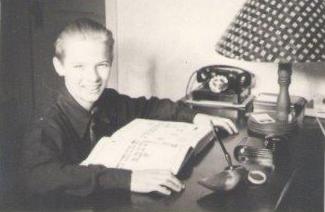
Cute kid, isn't he?  In this photo, his appearance
favors my father and my younger brother
Poor Babe - that celebrity probably heard all about that one banana pie she burned.

After dinner with the celebrity and a night in the sleeper car, the train arrived in Chicago in the morning.  And, in the process of switching trains, my young grandfather got impatient.

"I had this big heavy overcoat on and my suitcase, I mean, I was loaded down.  And the conductor is checking everybody’s ticket, and I thought that was dumb, why’s he checking?  So I slipped by him, I didn't have him check my ticket ... well, that was a bad decision," Dinon said.  "I met the traveler’s aide man at the station right there at the train, and then we went into the station, and then he looked at my tickets, and he said, ‘Well, where’s your pass to the next train station?’ because I didn't get my pass at the train station in Chicago, so of course I didn't have one!  So he had to make all kinds of telephone calls to get it ok'ed to let me transfer from one train station to the other.  And then he arranged it, and they put me on the 'Hiawatha', which was, at that time was a part of a number of trains that were named.   If you were going to San Francisco, why, there’s ‘The City of San Francisco’, but the 'Hiawatha' went from Chicago to Minneapolis-St. Paul and went through Wausau."

In the end, he made it to Wausau on the 'Hiawatha' train, and the little Boyer family was whole again, beginning a new chapter of their lives in the American Midwest.


SIMILAR STORIES
Pittsfield
MA
Nahant
MA
Nahant, MA
Wartime


Sunday, April 21, 2013

Nahant, MA: Wartime

(click here to read previous story: Nahant, MA)

Between the ages of 5 and 11 (1936-1942) my grandfather, Dinon, lived on one square mile of land, a peninsula called Nahant off the shore of Massachusetts, just a little northeast of Boston.


Dinon's father, my great-grandfather Ralph, worked on the mainland end of the Nahant causeway in the town of Lynn, MA.  He was a chemical engineer, working in the plastics division for General Electric.  In 1936, he had a 5-year-old son, Dinon, and a pregnant wife, Babe.  It was just 6 years after the start of the Great Depression, and he was fortunate just to have a job.


In September of 1939, Germany invaded Poland.  By then, his sons, Dinon and Daryll, were just 8 and 3 years old.  And, in spite of everything, he had been talking with Babe about even having a third child in another couple of years.


Something that is remarkably consistent in the way my grandfather, Dinon, tells his childhood stories is his tone of contentment and happiness.  In spite of being born in the outgoing tide of the Great Depression and being a young boy as the second world war brewed and broke, Dinon's childhood memories are happy.  I think it says a lot about my great-grandparents, Ralph and Babe, that Dinon's memories of the effects of the war on Nahant are all colored in the safety of adventure.


The first tangible effect was the sudden population of the golf course.

“When the war started, things changed, and we got more interested in what was going on with the war," Dinon said.  "We lived half-a-block from the golf course [what is now called the Kelley Greens at Nahant], a real nice golf course.  Then, all of a sudden, before the war started, before Pearl Harbor, the golf course became populated with barracks and soldiers."


The golf course is the biggest white space,
positioned to the west and north of Ft. Ruckman
(source)
Geographically, little Nahant played an important role as a gatekeeper for the Boston Harbor, located just to the south.  Combined with its height (above sea level), Nahant was tactically desirable, and became the most heavily armed site for the defense of the harbor1.  


Today: Battery Gardner Gun 1 and the Ft. Ruckman fire tower
(source)
"It was probably in the summertime of 1940, something like that, and since I was a kid, I became a mascot at one of the barracks.  There was a Sergeant Gymo (pronounced "JI-mo"), and a lot of the soldiers were from Midwest communities, and they'd never seen a beach before and they got burned," Dinon said, laughing.  "They’d lay down on the beach and think it was great, but sunscreen was pretty well unknown.  So they would burn, and they would come to me, and their backs were itching, so they asked me to peel their skin off – and I'd just take my hand and peeeeel it back – so it wouldn't itch so bad."

This is what my grandfather remembers about dozens of military personnel suddenly appearing where he lived - mascot status and peeled sunburns.

I have to wonder what my great-grandparents were thinking as they watched troops, equipment, and antiaircraft weaponry arrive on their tiny coastal home.  This was still pre-Pearl Harbor, but the radio was filled with news about an aggressive Germany and bombings in Europe and President Roosevelt's "fireside chats".  What went through their minds about their two young boys when ration stamps were issued, black-out curtains and curfews were enforced, and the men and women of their community were called to help with the war effort?


“My dad was air raid warden, and his job was to go around and make sure everybody’s black-out curtains were closed so you couldn't see any light," my grandfather said.  "We didn't want the German submarines to know where the coast was, and of course, this is a time before radar and sonar, so the U-Boats would probably have to surface and see where land was.  So my dad had a regular route of certain streets, and he'd go his rounds and check to make sure the black-out curtains were in fact all closed."

Even the automobiles had black-out standards for protection, and slotted covers were attached to headlights.

“The vehicles had what looked like cats' eyes for illumination," Dinon said.  "The light from the headlights were directed down instead of out in front, and they were a lot dimmer than the typical headlight.  But there were going very slow, and they didn't have the traffic at night at that time, in 1941 and ’42.  It was an entirely different time.”

But even if a U-Boat had floated up and a few Germans had come ashore, there's probably not much Ralph could've done.

"His only weapon was a billy club, a small fat billy club with a lead core in it.  It was heavy, but I don’t know what they expected him to be able to do with it … y'know, if the Germans landed and had guns, what’re you gonna do with a billy club against a luger?”

But in spite of the potential threats and uncomfortable restrictions, life - work, school, laundry and meals - had to go on.

Dinon, on the porch
 of the Nahant house

“We had rationing of food," my grandfather said.  "You had to have blue stamps for canned goods, and red stamps for meat and dairy products.  When you went shopping, you had to have your food stamps.  And then there was a ration card for gasoline, and if you were declared as needing gasoline to get to and from work, you were given a gasoline ration for that.  I know my father had [gasoline] rationing.”


Later in life, my grandfather developed a stamp-collecting hobby; in his collection, he still has some of the ration stamps.

“It was a very interesting time.”

Not terrifying, uncomfortable, or uneasy.


Interesting.


The Boyer family continued to live in Nahant until 1942, when Ralph took a job at a paper mill 1,200 miles away in Wausau, Wisconsin.  Dinon was 10, almost 11, and his brother Daryll was about 5 years old; their baby sister, Glenda, was either on the way or newly arrived at that time.  Dinon remembers being angry about the move, because he loved Nahant and being able to see the ocean in two directions from his bedroom window. He never lived on the coast again.  But, years later, he revisited the little peninsula with my grandmother, Elizabeth.

“Liz and I went to Nahant when we drove out East, and we decided we’d go visit where I lived," he said.  "And so, we drove up to the house, and we parked across the street from it and I started to take pictures of the house.  Well, that really upset the owner – the woman’s husband wasn't there – and so this woman called her son, and her son said, 'Go out and find out why they’re taking them.'  And so, when I told her that I used to live there when I was a kid, she invited us in and they had not changed that house really at all, it was still the same as I remembered it as a kid.  She allowed us to go upstairs into the bedrooms, and ... I could still see the ocean in two directions.”


Source: http://www.coastdefense.com/nahant.htm

(Next story: From Nahant to Wausau)


SIMILAR STORIES
Pittsfield
MA
Nahant
MA
Special
K Loaf

Sunday, April 07, 2013

Nahant, MA

(click here to read previous story: Pittsfield, MA)

In 1930, Ralph and his new bride, Babe, moved to Pittsfield, Massachusetts so that Ralph could begin his new job as a chemical engineer for General Electric's plastic division.

In 1936, my great-grandfather Ralph was transferred to General Electric's plant in Lynn.  So he picked up his pregnant wife and preschool son, Dinon, and moved from the west end of Massachusetts all the way to the tiny peninsula of Nahant on the seaboard side.


The 1936 move, 120+ miles from Pittsfield to Nahant
Nahant: A single square mile peninsula of land

Since my grandfather, Dinon, lived here for 6 years between the ages of 5 and 11 (1936-1942), he remembers Nahant better than Pittsfield.

“In Nahant, it was a regular town, because they had a town hall, a library, and they had a few small stores," Dinon said.  "I remember there was one store that I passed all the time that was run by a Jewish man that had candy.  So I would rob my globe bank and buy some candy on the way home ... I would probably buy licorice.  I don’t remember them having red licorice or any other color, if you got licorice it was just black.  Some of the licorice they made into the shape of a pipe.”


“In the house we lived in, I could see the ocean two different directions from my bedroom - you could look out it at a forty-five degree angle and see it one direction, and at forty-five the other way and see the ocean, and of course when I lived there I thought it was great, I loved living there.  I loved it," Dinon said.  "When we had a storm, dad would take us down closer to some place we could watch the waves come in and splash against the rocks, and watch the foam go waaaay up in the air.  I mean, way way up.  I thought that was really great."


"Big tree after Sept. 1938 Hurricane"
(source)
In September of 1938, the Great New England Hurricane blew by - and was just another adventure for a happy seven-year-old boy.

"My dad was out of town on business, and he tried to get back but he couldn't, the storm was so bad.   We lost power and it was dark, so Mother had to light some candles," Dinon recalled.  "The next day, a lot of the big trees were lying down, and of course the roots were vertical because they just toppled over.  Well, gee, going to school you either went over the tree or around it, and I thought, 'Well, this is great fun!'"

"I remember my father had arranged for one of our neighbors from Pittsfield, the Gigerichs, to come and have a fishing trip.  This was just after the hurricane.  I remember we went on this boat, and the ocean had swells that go way up, and way way down, and way way up, and way way down," my grandfather said, chuckling and waving his hands to illustrate.  "Everybody on that boat got seasick except me and their daughter, Judy, who was about my age."


Since it took a while for his baby brother, Daryll, to get big enough to play with, it was common for Dinon to run around the island on his own.  One spot that he liked was the mile-long causeway that connected Nahant to the mainland.


Old Postcard of Castle Rock and Egg Rock
(source)
"On one side, it had this beautiful white sand beach. I never went down to just lay on the beach – I wasn't really that crazy about sand, y'know, walking in the sand, getting it between my toes and all that, but I liked to climb on the rocks," Dinon said.  "On the other side of the road, there were these HUGE rocks; I don’t where they quarried these, but they were MONSTROUS, huge.  And they just dumped them there, they didn't try to build a wall or anything with mortar and all that kind of stuff, they just dumped them to help hold the causeway.  But these big rocks really fascinated me.  Since they were dumped there willy-nilly, why, there were lots of crevices that you could crawl around through, and so, by myself, when I was six or seven years old, I would crawl through the crevices these rocks had in them, until one day I darn near got stuck at the bottom, and I panicked.  I got out, obviously, but I never went back."

And sometimes he would even hitchhike (a common way to travel in that time) over the causeway to Lynn, the town where his father worked.

"I was really a bad boy," my grandfather said, folding his hands and shaking his head.  "Most people do not know that I would hitchhike into Lynn and would shoplift from some of the drugstores – take a flashlight, or something, nothing very big."

As he told this story, he was sitting in the neatly-maintained home that he purchased 40+ years ago with his life-long wife, the same house that they raised their four children in.  Even now, in his eighties, he continues to landscape his yard, fix his gutters, pay his taxes, and go to church every Sunday.  In that living room, the thought of my grandfather shoplifting at any age was stupefying.


Old Postcard of Bass Point Beach in Nahant
(source)
"One day, the police came to the door at my home," Dinon said.  "Well, I denied it, I flat-out denied that I had anything to do with it, because there was another kid that was doing the same thing.  We stashed our ‘loot’ in some abandoned building … I guess we did it because it was something to do.  After the policeman came to the door, I just quit, I mean, that was it, baby!  I wasn't taking any more chances, I didn't want to be a crook!  But there was a short time in there that it was more fun than anything else, that I was doing it and not getting caught, but I came very close!"

He chuckled, embarrassed.

"I don’t have any clue as to why they came to the door, because this was early evening when the policeman showed up.  So, my guess now is that they caught the other kid and he ratted me out, that’s the only thing I can think of.  But it was a time, and I was glad to finally get back on the 'straight and narrow', I guess," he said.  "I don't think my parents ever found out.  I told [your grandmother] Liz, but very few people know that I did that, and I don’t even think any of my kids know.  But you know, as a kid, you do some dumb things – you get in the wrong crowd, or, whatever, and veer off the 'straight and narrow'."


From then on, he stuck to fun within the law, like Kick the Can and chewing tar.

"Some of the streets were paved," he said, and held up his hand, making a quarter-sized circle with his thumb and forefinger. "We liked to get a chunk of tar and chew it.  It would be the 'pure' tar that they used on the road, and in the summertime it would sometimes bubble up, and so the kids oftentimes would get some of it and chew it."

Another favorite treat was ice chips. 

Their home in Pittsfield didn't have an ice box (Dinon's mother, Babe, would keep the butter on the outside window ledge during the winter), but here in Nahant was a different story.

"In Nahant, my mother had a refrigerator that used ice, and I always used to like to see the ice man come around in the wagon – I think it was a little truck – and we always tried to get the ice chips from the ice man," Dinon said.  "When the ice man would come around, I always went to the back of the truck to try to get the little ice chips, because he’s got a big block of ice and he’d chop off a block to take in, and he had these big tongs, and he’d carry it in and put it in the fridge."

At the Nahant home, in the
sailor suit his mother made
According to family stories, his mother, Babe, was a gold standard for the housewife.  She stayed home with the kids, was a famously good cook, and was great at making clothes for all the family members.

"My mother was an excellent seamstress, I mean, she could make my dad’s dress shirts, and everything," he said.  “There was a sailor suit that my mother made for me when I was in Nahant.  And, boy, I was proud of that.   She made that sailor suit, and with the jacket I looked really sharp … I had these nice big brass buttons on it, and I was so proud of that, golly!  And I would guess that that would probably be right at the beginning of when the war started … I don’t know for sure, but that’s what I would guess.” 

But even the happiest childhood in the 1930s couldn't wholly avoid the effects of a brewing world war, especially when it was lived on a vulnerable spit of peninsula on the eastern seaboard.


Wednesday, April 03, 2013

Pittsfield, MA

One thing I have learned to never under-estimate is the power of old family photos.  The emotional impact, and story-telling power, of a single photo is always incredible to me, even when the photos are of another person's family. So imagine how hard it was for me to breathe when one Saturday, in the middle of interviewing my 80-year-old grandfather, Dinon, he pulled out a photo album arranged by his mother.  

November 1931: Alma
and infant son Dinon
I felt my heart stop as I pulled back the cover to find black pages neatly arranged with photos and handwritten captions of my great-grandparents' courtship, wedding, honeymoon, and early marriage.  Even though I had the chance to meet both of my great-grandparents before they passed, Ralph and Alma (better known as "Babe") are little more to me than faint childhood recollections of a stoop-shouldered man and a tiny wrinkled woman.  But in the pages of that photo album I got to glimpse them at a time when they were my age, young and newly married.  In these photos, my great-grandfather's shoulders were straight and strong, and my great-grandmother was once an absolute knock-out.

According to notes in Babe's neat handwriting, she met my great-grandfather, Ralph Boyer, in their home state of Illinois on October 26th, 1927.  They were engaged the following August, and were then married in August of 1930 after Ralph graduated from the University of Wisconsin with his master's degree in Chemical Engineering.  Shortly after, he and Alma moved to Pittsfield, MA, a city 100 miles west of Boston, where he worked for General Electric in their plastics department.

Spring of 1932:
Ralph, Babe and Dinon
Their firstborn child was my grandfather, Dinon.  He was born on October 26, 1931 in Pittsfield.  He ended up as a belated birthday present, born the day after his mother's 23rd birthday.

The small Boyer family first lived in an apartment as they got on their feet, Ralph working as an engineer and Alma staying home with the baby.  "My mother remembers putting butter out on the window ledge in wintertime, because I’m not sure if they had a refrigerator at that time,” my grandfather said.

Dinon enjoyed a few years as the only child - his famously-pragmatic parents waited 5 years before their second child, and another 5 years after that before their third, so that they would only have to pay for one child's college tuition at a time.

In their defense, there were plenty of reasons why the pair was so frugal, even though Ralph was well-employed.  After all, both were born on farms in Illinois, and Babe's childhood farmhouse had a dirt floor.  And the economic climate of that era was far from comforting.

"You gotta remember, this was during the Depression, and although my dad always had a job there were a number of times that he took a pay cut," Dinon said.  "He graduated from the University of Wisconsin in 1930, so he was very fortunate that General Electric hired him.  The start of the Depression was 1929, so in 1930 it was tough.  And then I was born in 1931."

Whatever financial stresses his parents might've endured, my grandfather's memories of his childhood, even his very earliest ones, are of being happy, loved and provided for.

Before Dinon's first birthday, Babe and Ralph bought a new dining room table, the same table that Dinon inherited and later raised his own children around.

"My parents told me that one time I crawled under the table, and got balanced on my tummy so that I couldn't go forward or backward, I was just there," Dinon recounted, chuckling.  "There’s a piece in the middle under there, so, as a baby, I just crawled up in there, and I was stuck, and all I could do was cry.  I mean, I was just, there, couldn’t go forward, couldn’t go backward, I could flail my arms and all, but there was nothing that touching!  So I was rescued, y’know.”

He also remembers playing under the huge rhubarb leaves of his neighbor's victory garden behind their garage, and even attempting to ice skate before his fifth birthday.

“Of course, as a kid, I ice skated," Dinon said.  "I seem to remember doing some ice skating when I lived in Pittsfield ... It was kind of on a little stream.  The ice was curved, it was low in the middle and came up on both sides, which made it a little hard to skate.  And, of course, my skates were not the professional kind, and therefore, my ankles were not strong enough to stay up, so they kept going out.  So it was hard to skate that way.  I can still picture that stream in my mind.”

Even his minor pre-school surgeries are remembered by my grandfather mostly for the pleasant memories of the healing. 

“I had my tonsils out when I was very young, I don’t know what age, but I still remember, after having the tonsils out, wanting to suck chipped ice," Dinon said.  "And I had operations on both of my big toes [because I had ingrown toenails], and ... after the operation on my toes, I had them both wrapped, and my parents put me in a wagon.  I was very young, I think it was before I was in school, but it was in the summertime evidently because while I was healing, why they put me in a wagon and took me to where I could watch some houses being built.”

Around the time that Dinon turned 5 - and also close to the time that his brother, Daryll, was born - his father, Ralph, was transferred from the General Electric plant in Pittsfield to their plant in Lynn, MA, right on the Atlantic coast.  So, around 1936, the small Boyer family picked up and moved just east of Lynn, in a town on a tiny chicken-necked peninsula called Nahant.


(next story: Nahant, MA)


SIMILAR STORIES
Nahant
MA
Nahant, MA
Wartime
Special
K Loaf