Monday, December 16, 2013

3 Tips for Successfully Directing Overly-Talkative Interview Subjects

Interviewing is a skill that varies from person to person, with factors ranging from personality, history, health, circumstance, and more.  This series of posts about successful interview techniques shares solutions to common problems encountered while interviewing individuals for their personal and family stories.

Interviewees come in various levels of talkativity.  On one end of the spectrum, there's the stoic Man of Few Words; on the other end is the Babbling Brook, who just keeps talking forever about anything.  Babbling Brooks are the kind of people that, before you know it, it's been thirty minutes since your last question and somehow you're listening to a detailed account of a steak dinner twenty years ago (true story - that happened to me) when your last question was "Tell me about your wedding day".  You don't need to feel overwhelmed by the torrent - you just need to follow three simple guidelines to dam and guide the flow.

Babbling Brook types love to tell stories - the trick is
hearing the stories you want to learn more about
(Digital artwork by criminalatt)
One good example of a Babbling Brook type comes from inside of my own family:

My grandmother Liz was an energetic force to be reckoned with; because of her strong personality, it's not surprising that most of my memories of my grandparents are of my grandmother talking (often over others) and my grandfather sitting quietly on the sidelines.  After my grandmother passed away, I sat down to interview my grandfather and was shocked to find him in the Babbling Brook category.  I guess he didn't get much chance to talk when I was growing up, and now, with a recorder in front of him, he wouldn't stop talking long enough for me to take a bathroom break.

As the hours passed (he talked for NINE HOURS), I realized that I was hearing a lot about his career and very little about his marriage and the raising of his family, the latter being topics I was more interested in.  So I had to figure out how to turn the flow of memories from work to family.  The following three strategies that I developed that day have continued to help me in my work with other Babbling Brook-type clients as well.

(1) Interrupt Them Mid-Sentence
I know, sounds rude and risky, but sometimes it's the only way to redirect the conversation.  Babbling Brooks usually have such a volume of word flow that there are no breaks for you to naturally cut in.  With a smile and a warm tone, simply break in by saying something like, "I love hearing these stories about your career, and I'd like to hear more about your years as a teacher, but we haven't talked much about your wedding and I'd really like to hear more stories about that."  In that way, you affirm the value of the stories he obviously likes to tell, while still redirecting him to a story you want to hear. Sometimes they'll insist on finishing the story they were telling, so agree with a laugh and bargain lightly with them: "OK, but after this story I want to hear more about your wedding day."  Odds are good that he'll try and tell another career story anyways, but if you playfully remind him (possibly mid-sentence again), "Hey - we had a deal!" he'll probably honor the bargain and share a story or two about his wedding.  (A good thing to keep in mind is that interrupting them carries surprisingly little risk.  Babbling Brooks are so happy to have attention and a listening ear that often it almost doesn't matter to them what story they're telling; it's a compliment to them that you're interested enough to request a specific story or detail.)

(2) Persistently Ask Specific Questions
Every person has a set of stories compiled over the years of their life, some of them sweet and some of them painful.  Some stories are more difficult to share than others, and when you're seeking out someone else's painful stories it can be nearly impossible to draw them out.  In the case of my grandfather, he had a happy childhood and a successful career, but his marriage was difficult.  He was a Babbling Brook when it came to childhood games and the students he caught cheating, but questions about my grandmother were met with a gruff two-sentence answer before he went back to childhood stories.  I did not want our time to turn into an uncomfortable interrogation, but I also really wanted more information about my grandmother, so I had to adapt.  In order to learn more about his marriage, I had to be patient, persistent and very specific.  Between stories that made him happy, I would ask short specific questions: "Where did you and Liz go on your honeymoon?"  "What was the name of the church you were married in?"  "Why did you pick the name 'Diann' for your first child?"  It worked: while he would not talk in length about his marriage, he would faithfully give me one or two-sentence answers when I asked specific questions, and even remained in a good mood.  Sometimes I could even press him with a couple questions in a row before he changed the subject; each time, I would tactically retreat for a couple stories, and then press him again with another question a few minutes later.  Because of the painful nature of these memories, the stories and details I wanted to learn involved much more intentional effort to glean, but it was more than worth it.  So don't give up when a certain topic seems closed: some stories are just harder to learn about than others, and gentle persistence can go a long way toward opening a closed door.

(3) Use Photos Related to What you Want to Know
Photos are far and away my favorite interview tool, and for Babbling Brook types they offer the perfect assistance for redirection.  Almost everyone has a photo album, scrapbook or shoe box full of sentimental photos, and if you have that spread across your lap or opened on the coffee table it becomes a powerful and natural segue into a more desirable topic.  Page through it while they're telling stories, pick a picture that relates to a time of their life you want to learn more about, and use it to redirect them when necessary.  Since Babbling Brook types often need interrupted, as discussed earlier, I often soften the break-in with a compliment:  "Look how beautiful you are in your wedding dress!" or "Your boys were so CUTE!  Look at this picture!"  It's usually more than enough to redirect their attention to the photo, and give you a chance to ask, "So, you got married in July - was it hot that day?" or "Your boys were only eleven months apart - was that planned?"  You also gain the added benefit of the photo's memory assistance, which is often enormously helpful.


Want to learn more about successful interviewing techniques?  Follow Memories in Print on Facebook, Twitter or Google+ to keep up to date on upcoming interview posts, such as how to draw out a man of few words, creative strategies for interviewing subjects with memory issues, and more.

Thursday, November 21, 2013

Five Minutes of Fame: Promoting Memories in Print on "Daytime Columbus"

So, this happened:

"Preserving Family Memories", The Daytime Columbus Show, NBC4i.com


That's me!  And my books!  On TV!  Crazy, right??

I owe a lot of thanks to a lot of people for both getting to do this and looking halfway decent at it:

First, to the Daytime Columbus team at NBC4 who cued me, miked me, filmed me and gave me a complimentary bottle of water - after seeing the final cut, I know they did wonders to make me appear more polished and coherent, for which I'm exceedingly grateful.  Also, Gail Hogan was a very sweet and personable host whose warm professionalism did a lot to calm my desire to throw up on the coffee table.  Every minute in that studio was an enjoyable experience.

Second, to the unequalled Beth Buxton of Edwards Funeral Service.  She called me up, asked me to share one of her weekly TV spots with her, and helped guide my preparations with continuing generosity and good humor.  And when the first airing of the segment I was in got blotted out by a presidential announcement, she again went above and beyond and insisted that my clip air AGAIN the following week instead of filming a new segment.  In short: Beth is amazing - do yourself a favor and find a way to work with her.

Third, to the brave handful of previous clients who gave me their permission to share their beautiful books on camera: to Rachel and Dennis, Jane and Earl, and to Shelli.  I loved working with each and every one of you more than I can describe. Thank you for letting me share your books and stories so that I can continue to do this work for others - you guys sell me better than anything else.  (A special thanks to Rachel, specifically, who drove more than an hour to Columbus to try and watch the clip air the first time - without her efforts, we wouldn't have known that the clip needed a second airing!)

Fourth, to the support I received from friends, family, everyone, for this video.  For every person who asked "how'd it go?", every hug, every phone call, every text, every "like" and Facebook comment and repost and shared link, you guys rocked my world.  Every time I began to panic that I would screw this opportunity up, I always received a perfectly-timed piece of encouragement that allowed me to continue preparing with renewed confidence.  Thank you so much for that invaluable gift.

And, last and most, enormous thanks to my husband Dave.  Not only does he support me in every way as I grow my business, he bought me new makeup, picked up undone chores without complaint, rehearsed interview questions late into the night, and encouraged my ability to nail the spot.  All confidence I exude in this video is thanks to him.

Tuesday, November 19, 2013

Ice Dancing in Troy

(click here to read previous story: The First Son)

When the Boyer family moved from Cuyahoga Falls to Troy, OH in 1960 (or '61), they came with two baby girls.  In their short time in Troy, they welcomed their first son to the world, and when they moved back to Cuyahoga Falls in the summer of 1965, they brought back two little girls and their new baby boy.

However, an accounting of the family's years in Troy would not be complete without stories of Liz and Dinon's involvement in the skate club at the Hobart Arena.

Hobart Arena in Troy, OH
(Source)
"It was a big part of our social life in Troy," Dinon said.  "Most of the people that belonged to it were pretty well-to-do, so we rubbed shoulders with the [higher-ups].  I was personnel manager of the plant down there, so I guess that was high enough to warrant me being able to join."

Dinon especially was deeply involved in the club and participated on all levels, from casual skating to competitive ice-dancing, from records keeping to managing the annual ice show.  

"We heard about the skating club when we moved to Troy.  I don't remember who mentioned it or told us about it, but I said to Liz that that would be a fun thing to do," Dinon said.  "So every week we had lessons from the [local] skating pros [who did the choreography for the ice show], and they would teach us different moves, and then we had some free time to skate around and do what we wanted.  So, it was an enjoyable time to go there and learn.  We'd get a babysitter for the kids, and then we'd go skating."

He liked it so much he brought coworkers with him, too.

"I remember there was an engineer that we hired from India, so he had hardly ever seen ice or snow.  So I enticed him to join the skating club," Dinon said, chuckling.  "He was so scared, he would hold on to the edge all the way around, and if he started at all to fall, why, he'd grab on with both hands!"

Liz never liked ice skating quite enough to go by herself, but Dinon often went alone during open skating just for the exercise.

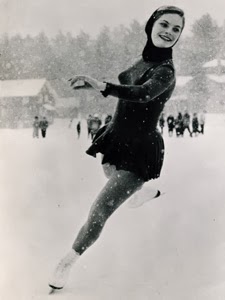
Carol Heiss, winner of the gold medal
in the 1960 Olympics and
five-times world champion (1956-1960)
"For fifty cents, you could get in for the whole evening, so it was real cheap entertainment," Dinon said.  "I'd go for exercise and skate fast and really work up my energy level, and maybe work on one of the moves that I would have to do in the ice show ... I was never gonna be one that could twirl or do some of these things, but regular skating, yeah, I enjoyed that."

The skating club put on an ice show for the community every year, pulling out all the stops.  "We got props and costumes and we always had somebody who was well-known, a top-notch skater, come out - Carol Heiss came and skated for us one year."

Dinon had loved to go out dancing when he was in college, so it was hardly surprising when he ended up competing in the ice show one year.


"The lowest level of ice dancing is skating the Dutch Waltz," Dinon said.  "Oh, I loved the Dutch Waltz.  I mean, when I was in college, I danced a LOT.  [For the competition] I skated with another woman, a single lady, I don't remember her name now, but she and I practiced.  Liz wasn't really a good enough skater to do it, she couldn't concentrate enough [because] of her ADD.  So anyhow, this other woman and I skated to the Dutch Waltz, and we got our names put on the trophy - it's permanently there, and we were the first ones to get on to it.  I think they had several couples dancing the Dutch Waltz and we did it the best.  I enjoyed it.  I never advanced beyond that, because the other dances were, well, they were more complicated.  Part of the time you were skating backwards or twirling or something, and that was beyond my skill.  But I loved to dance, so I'd make these real wide curves, and had a ball, because the Dutch Waltz was something I could master."

Diagram of the Dutch Waltz
(Source)
He liked the experience well enough to repeat it and performed on ice again.  In March of 1963, Dinon ice-danced in lederhosen at the Alpine Festival's International Ice Review.  All of the skaters in the Review received a 12-inch tall copper mug with the inscription of the event and date - and it still sits in a place of honor, on a high shelf in Dinon's study.  "I've always kept this," he said.

The club appealed to Dinon for many reasons, from his natural love for dancing to his meticulous attention to detail.

"Part of the time I was in the club, I kept track of the levels of the various skaters," Dinon said, "and these records were very important as they progressed.  For a while I judged the figure eights, and I kept the records for one year.  It was fun, it was just an enjoyable thing to do."

He even volunteered to manage the ice show one year.

"Different people became the general manager of the show ... it didn't really rotate, but different people volunteered, and we always had a budget, and we'd get different things - some for costumes, some for special lighting - I mean, all kinds of things," Dinon said.

Now, there are two important things to remember about Dinon: first, that he was raised by frugal Depression-era parents and second, that he is naturally very literal and extraordinarily detail-oriented.  Therefore, when Dinon Boyer is given a budget, he sticks to that budget.  Period.

"During the time I was there, the only year that the club made money was when I ran the ice show," Dinon said with evident pride.  "And I ran it with an iron fist.  We had a budget, and we all agreed on it, and I kept them to the budget, so we didn't have any wild spending like we always did other years.  Somebody always wanted to do something, and in the past they'd say, 'Yeah, go ahead,' and they'd do it and submit the bill and be way over budget.  So I was determined that we were gonna be on or below budget, and that we were gonna come out and have some money for the club.  And I accomplished that because I kept tabs on what the different groups were spending and doing, and kept reminding them about the amount of money they had, and I told them that if they wanted to do more they had to get innovative about it because they only had this amount of money ... and it worked.  We had a good show, we made money, so that was my legacy to the skating club."

It's a legacy he's proud of, and in line with the rest of his life.  Dinon was always an excellent provider for his family and wife.  And, decades laters, he still takes pride in having been a good provider during that ice show for the skating club he loved in Troy.

"It was a good time.  I'm glad we had the opportunity," Dinon said.  "After we got transferred back to Cuyahoga Falls from Troy, we tried to find a place to skate nearby.  We found out Kent State had a rink, but it was never in really good shape.  I don't remember if they even had a zamboni or not.  We soon lost interest in going out to Kent.  We probably had other priorities."


(to be continued)


SIMILAR STORIES